From Knowledge to Wisdom: The Educational Philosophy of Shri Krishna’s Gurukul Journey
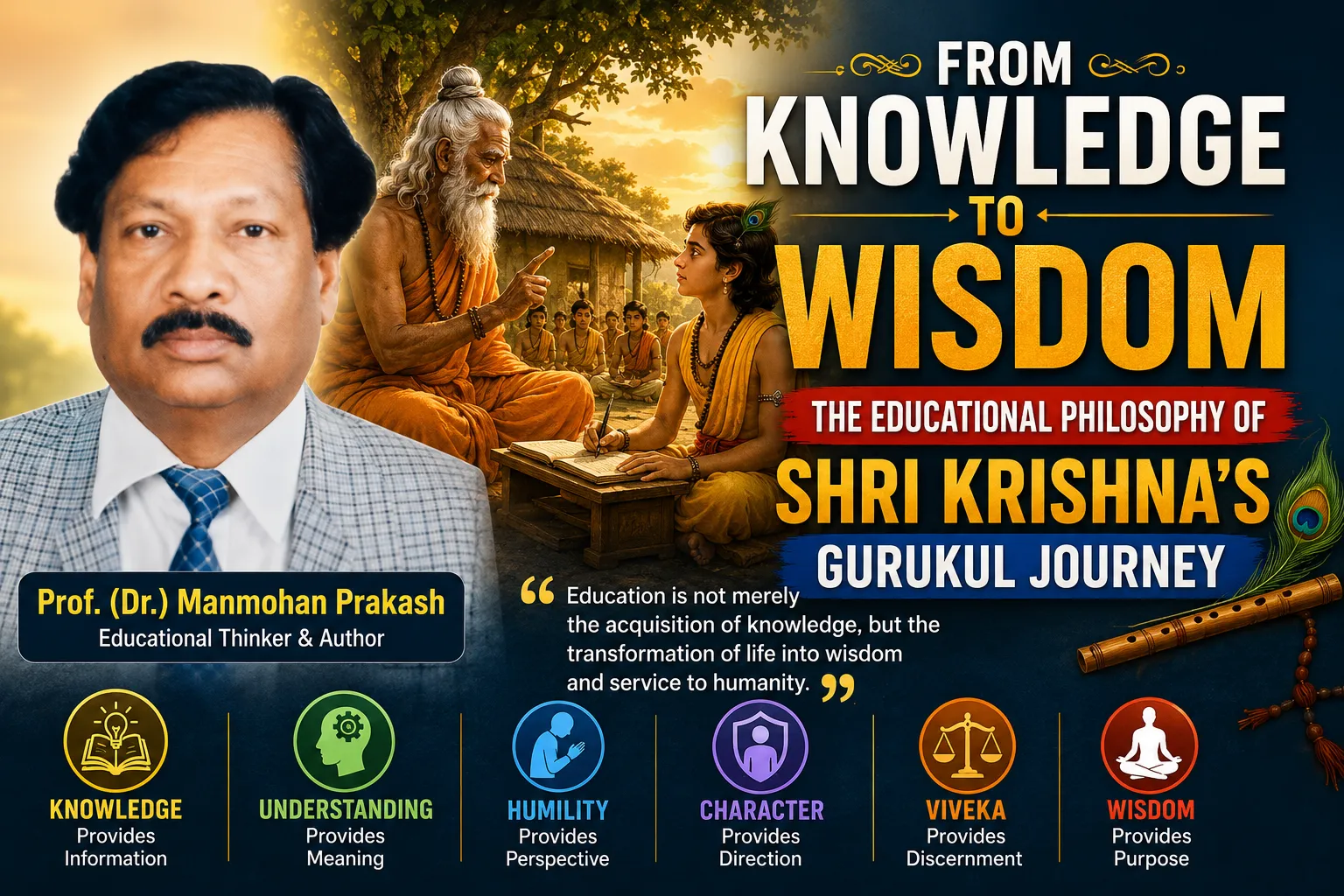
Prof. (Dr.) Manmohan Prakash
In the Indian Sanatan tradition, Shri Krishna’s education at the Gurukul of Maharshi Sandipani is not merely a mythological episode from the past; it represents a profound philosophy of education whose relevance extends far beyond its historical or religious context. The story presents education as a transformative journey:from knowledge to wisdom, from information to understanding, from discipline to character, and ultimately from individual accomplishment to social responsibility.
At a time when education is increasingly evaluated through marks, degrees, professional qualifications, employment, and competitive success, Shri Krishna’s Gurukul journey invites us to reconsider a fundamental question: What is the ultimate purpose of education? Is education merely a means of acquiring information and securing a livelihood, or is it a process of transforming an individual into a wise, responsible, disciplined, compassionate, and socially conscious human being?The life of Shri Krishna suggests that true education must accomplish the latter.
Shri Krishna had demonstrated extraordinary abilities from childhood according to Indian tradition. Yet he entered the Gurukul and accepted the discipline of a student. This itself conveys a powerful educational message. Greatness does not eliminate the need for learning. Rather, the willingness to learn, the humility to accept guidance, and the recognition that knowledge is an endless journey are among the highest marks of an educated person.
The first lesson of Shri Krishna’s Gurukul life, therefore, is humility before knowledge.
Despite his royal background, Shri Krishna lived in the Gurukul as an ordinary student. He did not demand special privileges because of his birth or social position. He accepted the rules and discipline of the ashram along with his fellow students. The underlying message is clear: the true value of a learner does not arise from wealth, family, social status, or privilege, but from curiosity, dedication, conduct, and the willingness to learn.
This principle remains highly relevant to contemporary education. Education should be a great equalizing force. It should provide every learner with dignity, opportunity, and the freedom to develop their potential. If differences in economic circumstances determine the quality of education available to children, education may inadvertently reproduce social inequality rather than reduce it. The Gurukul ideal reminds us that the educational environment should cultivate equality, mutual respect, cooperation, and human dignity.
But knowledge without humility can become a source of arrogance. The Indian educational tradition therefore places great emphasis on the relationship between Guru and Shishya. Maharshi Sandipani was not merely a teacher who transmitted information; the Guru represented guidance, discipline, experience, and the wisdom required to understand life.
Shri Krishna’s reverence for his Guru illustrates this relationship. The traditional account of Guru Dakshina, in which Shri Krishna fulfilled his Guru’s request and brought back his Guru’s son, conveys a deeper message than the literal act itself. Education cannot truly be repaid merely through money or material offerings. The highest Guru Dakshina is the responsible use of knowledge.
A student honours the teacher not simply by remembering the teacher’s name but by applying the knowledge received in a meaningful and ethical manner. Knowledge becomes valuable when it improves conduct, strengthens character, serves society, and contributes to the welfare of others.
This leads to the second major dimension of Shri Krishna’s educational philosophy: education as character formation.
Gurukul education was not restricted to classroom instruction or book-based learning. Students were expected to participate in the daily life of the ashram. Discipline, self-restraint, service, cooperation, physical work, simplicity, and collective living were integral to the educational experience. Such practices cultivated self-reliance and responsibility.
The lesson is particularly significant in an age of increasing convenience and instant gratification. Modern technology has made life easier in many ways, but it has also created a tendency to expect immediate results with minimum effort. Education must therefore teach young people the dignity of labour, the value of patience, the importance of perseverance, and the ability to accept responsibility.
Marks and certificates may demonstrate academic achievement, but they cannot by themselves establish character. A genuinely educated person must also possess discipline, emotional maturity, resilience, empathy, and a willingness to contribute.
The relationship between Shri Krishna and Sudama provides another important dimension of this educational philosophy. Their circumstances were different, but their relationship in the Gurukul was marked by friendship, affection, and equality. Their story conveys a timeless message that education should transcend social and economic barriers and nurture respect for every individual.
If an educational institution produces highly qualified individuals who look down upon those who are economically or socially less privileged, something essential has been missed. Education should not merely increase intellectual ability; it should expand the capacity for empathy and human connection.
The Gurukul model also points towards holistic education. Traditional accounts associate Shri Krishna with learning across diverse areas of knowledge and skill. Whether these accounts are understood literally, symbolically, or culturally, they reflect an important educational ideal: human development cannot be reduced to specialization in a single discipline.
Modern education rightly values specialization, scientific knowledge, and professional competence. However, specialization without broader understanding can create technically capable but socially insensitive individuals. Education should therefore combine intellectual knowledge with practical skills, physical development, artistic sensitivity, ethical awareness, communication, social understanding, and the ability to make sound decisions.
This brings us to the central transition in the title of this article-from knowledge to wisdom.Knowledge tells us what something is. Understanding helps us recognize how it works. But wisdom enables us to determine when, where, why, and for what purpose that knowledge should be used.
This distinction has become especially important in the modern technological age. Humanity possesses extraordinary scientific and technological capabilities. Artificial intelligence, biotechnology, nuclear technology, genetic engineering, digital communication, and other advances have transformed human possibilities. Yet the possession of greater power does not automatically make humanity wiser.
Knowledge without ethical direction can be misused. Technology without responsibility can create new forms of inequality and destruction. Scientific advancement without wisdom may solve one problem while creating another.Therefore, the purpose of education cannot simply be to produce individuals who know more. It must produce individuals who know how to use what they know.
This is where the concept of Viveka, or discernment, becomes central. Viveka is the ability to distinguish between what is appropriate and inappropriate, beneficial and harmful, temporary and enduring, selfish interest and larger social welfare. In this sense, wisdom represents the mature stage of education.
Shri Krishna’s later life, as portrayed in Indian tradition, can be understood as an expression of this transformation from learning to wisdom. He did not confine his abilities to personal comfort or private achievement. He became a guide, strategist, statesman, and teacher, using his knowledge and understanding in response to the challenges confronting society.
The Bhagavad Gita represents the highest expression of this educational journey. On the battlefield of Kurukshetra, Arjuna faces a profound moral and psychological crisis. Shri Krishna does not merely provide him with information. He guides him towards clarity, discernment, self-knowledge, duty, and responsible action.This is the crucial distinction between instruction and education.
Instruction may provide answers; education develops the ability to ask the right questions. Instruction may increase knowledge; education develops understanding. Knowledge may provide power; wisdom teaches us how that power should be used.
The concept of Karma Yoga in the Bhagavad Gita further expands this philosophy. Action should not be abandoned simply because circumstances are difficult. Rather, one should perform one's duty with dedication while maintaining an appropriate attitude towards the fruits of action. In a broader educational sense, this teaches responsibility, perseverance, self-discipline, and commitment to duty.
From this perspective, the ultimate goal of education is not merely to create successful individuals but responsible individuals who can use their success for constructive purposes.This is one of the greatest challenges before modern education. We want our children to be competitive, but they must also be compassionate. We want them to become successful, but they must also become responsible. We want them to acquire technological competence, but they must also develop ethical judgment. We encourage individual achievement, but we must also cultivate social consciousness.
Education, therefore, must establish a balance between knowledge and wisdom, freedom and discipline, rights and duties, achievement and responsibility, modernity and cultural awareness, and individual aspirations and social welfare.
Seen from this perspective, Shri Krishna’s Gurukul journey is not simply a story about how a young student acquired knowledge. It is a philosophical representation of how education should transform a human being,i.e.
(i)The journey begins with curiosity-the desire to learn.
(ii)It develops through discipline
-the willingness to work and persevere.
(iii)It deepens through humility
-the recognition that knowledge is vast and one’s own understanding is limited.
(iv)It becomes meaningful through character-the ability to translate knowledge into conduct.
(v)It reaches maturity through Viveka-the capacity to distinguish between right and wrong and to make responsible choices.
And finally
(vi)It becomes wisdom when knowledge and discernment are placed in the service of life, society, and humanity.
This progression has enormous relevance for the contemporary education system. The crisis of education today is not necessarily a crisis of information. We live in an age in which information is available more easily than ever before. The real challenge is the ability to evaluate information, distinguish truth from misinformation, develop independent judgment, understand consequences, and use knowledge ethically.
Students today can access thousands of books, lectures, databases, videos, and digital resources within seconds. Yet access to information does not automatically produce wisdom. The teacher’s role, therefore, is changing but not disappearing. In an information-rich world, the teacher increasingly becomes a mentor who helps learners interpret information, develop critical thinking, cultivate values, and make responsible choices.
In this respect, the Guru-Shishya relationship acquires a renewed significance. The teacher is not simply a provider of information but a facilitator of intellectual and moral growth.
The educational philosophy reflected in Shri Krishna’s Gurukul journey also challenges the narrow definition of success. A person may possess a prestigious degree, a successful career, wealth, and social status and yet lack empathy, integrity, self-discipline, or wisdom. Conversely, a person who uses knowledge responsibly, respects others, performs duties sincerely, and contributes positively to society embodies a deeper form of educational success.
The real question, therefore, is not simply “How much has a student learned?” but also “What kind of human being has the student become through learning?”
That question lies at the heart of the transition from knowledge to wisdom.Shri Krishna’s Gurukul journey thus offers an educational philosophy that is simultaneously ancient in its origin and contemporary in its relevance. It does not suggest a mechanical return to the Gurukul system of the past. Rather, it encourages us to recover its enduring principles-humility, discipline, self-reliance, respect for teachers, dignity of labour, equality, friendship, holistic development, discernment, duty, and social responsibility-and integrate them with the strengths of modern education.
The education of the future must certainly prepare students for employment and economic independence. But it must do more. It must prepare them for life.
It must teach them not only how to earn a living, but how to live; not only how to compete, but how to cooperate; not only how to exercise rights, but how to perform duties; not only how to acquire knowledge, but how to transform knowledge into wisdom.
Ultimately, the philosophy embedded in Shri Krishna’s Gurukul journey can be expressed as a progressive movement i.e.
Knowledge provides information.
Understanding provides meaning.
Humility provides perspective.
Character provides direction.
Viveka provides discernment.
Wisdom provides purpose.
This is perhaps the most enduring lesson of Shri Krishna’s educational journey. The highest achievement of education is not the accumulation of knowledge but its transformation into wisdom and its application for the betterment of the individual, society, and humanity.
Education reaches its true destination when knowledge illuminates the mind, humility ennobles the personality, wisdom guides decisions, and responsible action serves society.