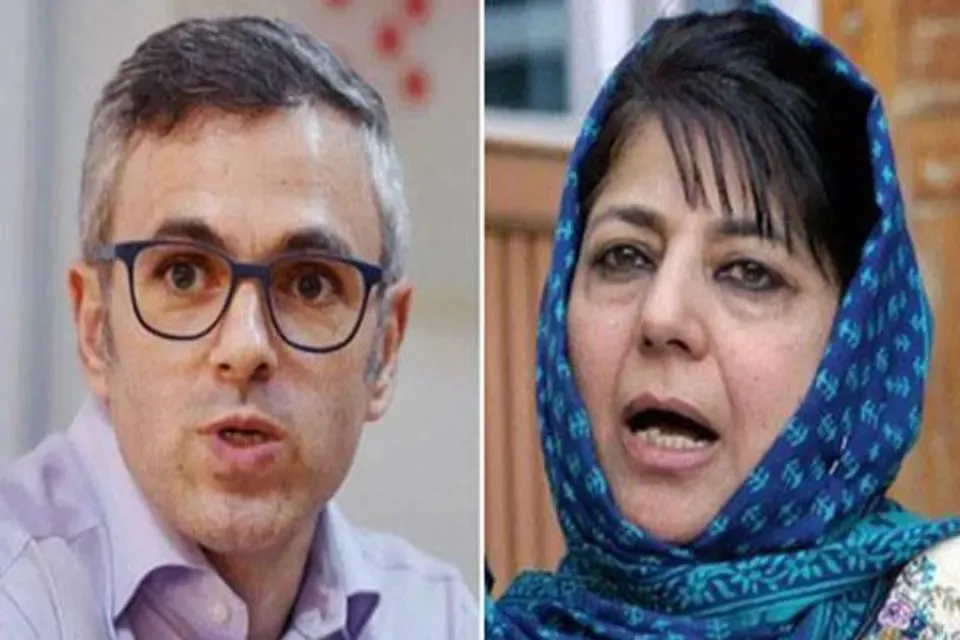
Srinagar, Jun 2: Opposition People’s Democratic Party (PDP) President Mehbooba Mufti’s latest appeal for a united political outreach to New Delhi has again brought into focus a recurring paradox in Jammu and Kashmir politics.
While every political party in J&K claims to represent the aspirations of the people of the region, they continue to struggle to act collectively even on issues above partisan politics.
A series of letters written by former chief minister Mehbooba Mufti to Chief Minister Omar Abdullah, BJP Legislature Party leader Sunil Sharma, and J&K Pradesh Congress Committee (JKPCC) President Tariq Hameed Karra demonstrated this aptly.
Taking note of the recent engagement between the Leh Apex Body (LAB), Kargil Democratic Alliance (KDA), and the Government of India, Mehbooba proposed that political parties in J&K jointly approach Prime Minister Narendra Modi and Union Home Minister Amit Shah for a “meaningful and sustained dialogue” on J&K’s future.
After sending the letters, Mehbooba, in her post on microblogging site ‘X’, posted, “J&K stands at a crossroad where we cannot let despair shape our future. Political leadership across the state must rise above politics to unite for peace and dignity of its people. A sincere and sustained dialogue with the Government of India is imperative. I have written to
@OmarAbdullah, @Sunil_SharmaBJP, @TariqKarra, and others, urging a united outreach to Hon’ble Prime Minister @narendramodi and Hon’ble Home Minister @AmitShah.”
Chief Minister Omar responded to the PDP chief’s post, writing, “Mehbooba Mufti Sahiba, we spoke on Saturday when you asked to meet. I told you I was in Pahalgam on Sunday and would get in touch on Monday or Tuesday to fix to meet. Your letter gives the impression that I’ve kept you waiting for an appointment for weeks on end, which is clearly not the case. Be that as it may, your letter to me is now in the public domain and I will be sending you a reply, similarly routed, once I’ve consulted my senior party colleagues.”
As soon as CM Omar clarified that he had not ignored her request for a meeting and that the two leaders had spoken only days earlier, the focus shifted away from the substance of the proposal toward the politics surrounding it.
The exchange highlighted a reality that even before discussions could begin on the proposed united outreach, old political mistrust resurfaced.
While Mehbooba’s argument stemmed from a perception that J&K’s political voice has become fragmented since 2019, NC’s being wary of getting drawn into the process whose contours remain undefined and whose public launch preceded private consultations is not misplaced either.
This exchange on 'X' is not as much about who is right and who is wrong as it is about the state of politics in J&K.
Mehbooba’s appeal carried echoes of the People’s Alliance for Gupkar Declaration (PAGD), the coalition formed after the August 5, 2019, constitutional changes, but NC’s response can be seen in the immediate death of PAGD when PDP walked away from the alliance over seat sharing arrangement in the District Development Council (DDC) polls.
Commenting on Mehbooba's outreach, NC chief spokesman Tanvir Sadiq told reporters that the issue was in the “larger interest” and would be discussed in NC's June 3 meeting.
“Everyone knows about the PAGD declaration and everyone knows who came out of PAGD. However, in the larger interest, the proposal will be discussed in Wednesday’s meeting,” he said.
Another aspect of Mehbooba’s outreach that attracted attention is its selective nature.
While her ‘X’ post referred to letters written to CM Omar, LOP Sharma, JKPCC chief Karra, and “others”, the letters made public so far have been addressed only to leaders of the NC, BJP, and Congress.
There has been no indication of similar outreach to Altaf Bukhari’s Apni Party, Sajad Lone’s Peoples Conference, CPI (M) leader Muhammad Yusuf Tarigami, or other political actors of J&K.
The omission has prompted questions about whether the proposed consensus is intended to be genuinely inclusive or limited to select stakeholders.
The reality is that nearly seven years after the reorganisation of J&K, political parties continue to articulate remarkably similar concerns on several core issues like restoration of statehood, protection of democratic rights, greater political empowerment, economic development, or rebuilding public confidence.
However, they differ often in strategy, political ownership, and leadership.
This is precisely why the latest episode has generated interest beyond routine political exchanges.
For people, the question is not whether CM Omar or Mehbooba scored more points in a social media exchange.
It is whether political parties that repeatedly invoke the “larger interests” of J&K, can even temporarily, set aside rivalries to pursue objectives they all publicly endorse.
The ‘X’ exchange between the PDP chief and the CM appears to be testing that proposition.
Whether Mehbooba’s initiative leads to an all-party meeting, a collective memorandum to New Delhi, or simply another round of political exchanges remains to be seen.
However, the exchange has already highlighted a fundamental challenge facing J&K’s politics: there is a gap between the rhetoric of larger interest and the reality of fragmented politics.